
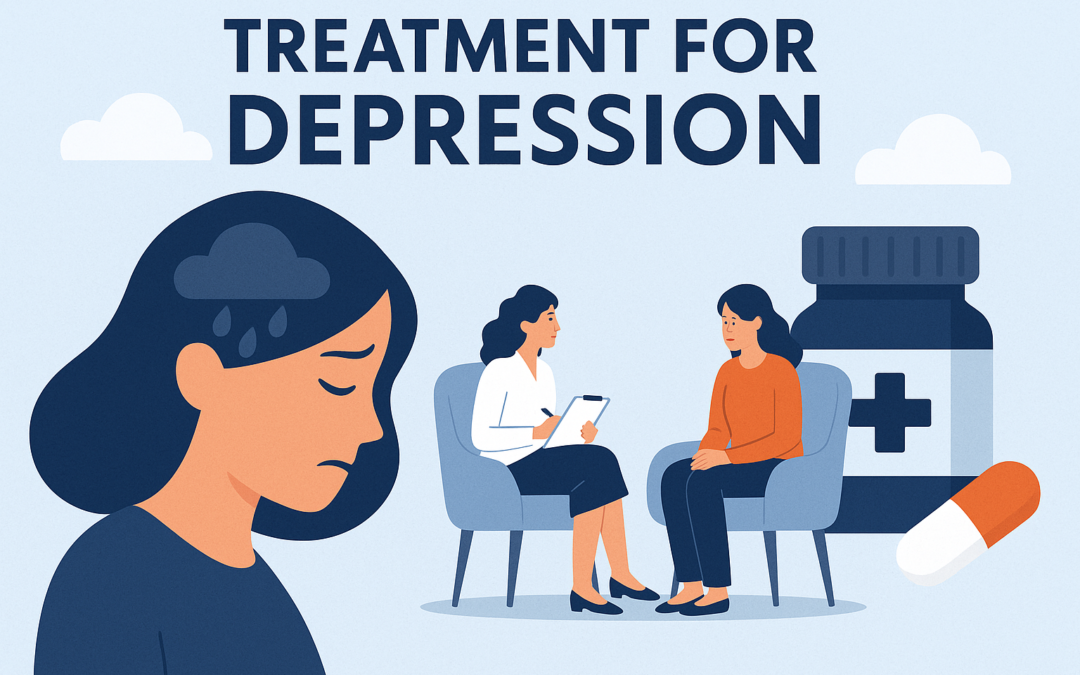
So here’s what I tell patients about depression treatment in Lewisville when they sit in my exam room — and I see this every single week in my practice — depression is treatable, and honestly, most people start getting better once we take the first step, whether that’s medication, therapy, or simply putting words to what’s been going on. And yes, primary care physicians like me manage the majority of depression and anxiety cases right here in the clinic. We usually start with either an SSRI or an SNRI… or sometimes a more activating or more calming option depending on the person. The main point is: you do not need to wait months to see a specialist before starting treatment.
Look, in North Texas, people are busy, stressed, commuting, juggling kids, work, aging parents — and depression doesn’t wait for the “perfect” moment. So we start treatment safely and early.
Let me just think out loud for a second — depression in North Texas, especially around Lewisville, Flower Mound, Coppell, all these growing suburbs — it shows up in ways that don’t always look like the textbook stuff we memorized in med school. And… well, actually, let me rephrase that, some patients do show up with the classic “low mood, no energy,” but most come in with something like, “Doc, I’m just not myself lately,” or “I thought this was just stress, but now it’s affecting my relationships.”
And then patients ask me the same question almost every time:
“Do I need to see a psychiatrist?”
But the truth is, primary care handles the bulk of depression and anxiety treatment safely and effectively. Most guidelines — including the standard U.S. preventive and psychiatric guidelines — fully support starting treatment in primary care when symptoms are moderate or impacting function.
Now, the next thing they want to know is… “Are medications safe? Do they change my personality?” And I get it. There’s a lot of misinformation out there. In general, antidepressant medications work gradually, adjusting neurotransmitter activity in the brain over several weeks. They don’t “numb” your personality. They don’t turn you into someone else. They just get your brain chemistry back into the range where therapy, lifestyle changes, and normal daily stressors feel manageable again.
But — and here’s where I interrupt myself because the real world is messy — not everyone responds the same way. Some people feel better within two weeks. Some need dose adjustments. Some need a different class altogether. That’s why we monitor closely. At Health Express Clinics here in Lewisville, we usually follow up within 2–4 weeks after starting a new medication. And you know what? That follow-up visit is where a lot of lightbulbs go off:
“Doc… I didn’t realize how heavy everything felt until it got a little lighter.”
A Patient Story (because real life is complicated)
Let me tell you about a patient — no identifying details of course — who came in feeling “off.” Mid-40s, two kids in school, working full-time in one of the corporate offices near 121. She sat down and said, “I don’t cry. I don’t get depressed. I just don’t.” Except she wasn’t sleeping well, she kept snapping at her family, and her work performance had dipped enough that her manager had brought it up. The guilt was eating her alive.
At first, she insisted it was thyroid issues or iron levels or perimenopause or “just stress.” (And honestly, sometimes it isthose things — so we checked.)
Labs were normal.
But her PHQ-9 score was well into the moderate-to-severe range. And here’s the teaching moment I share with medical students: people don’t come in saying “I’m depressed.” They come in with fatigue, irritability, headaches, stomach issues, insomnia. Depression wears disguises.
We discussed medication options — again, no brand names here — but the categories like calming vs energizing, daytime vs nighttime dosing, and the idea that therapy plus medication is often more effective than either one alone. She eventually agreed to start a first-line antidepressant. Slowly — and I mean slowly — she began noticing improvement. By her second follow-up, she said, “I didn’t know my brain could feel this clear.”
And then she said something I hear a lot:
“I should’ve come in sooner.”
Now, wait — let me think about this differently.
Because another thing I’ve realized in practice is that when I talk to colleagues, we sometimes assume patients know what “treatment” means. But many don’t. Some think antidepressants are addictive. They’re not. Some think treatment has to be lifelong. It doesn’t have to be. Some think primary care doctors only treat physical illnesses. That’s definitely not true.
In fact, I’d estimate easily 30–40% of a typical family medicine day involves mental health in some form — depression, anxiety, ADHD, stress-related insomnia, grief, postpartum mood changes…
And, yeah, ADHD overlaps with depression more often than people think. Sometimes treating the underlying attention symptoms stabilizes mood. Sometimes treating mood makes the ADHD symptoms easier to manage. And occasionally, well, you have to treat both — carefully — with the right balance of medications.
But then patients ask me:
“How do we know which medication class is right for me?”
Here’s how I actually break it down in the room:
- If someone has trouble with low energy and feels “slowed down,” I’ll ask about options with slightly more activating profiles.
- If sleep is disrupted, or anxiety is crowding the picture, I think about medications with more calming effects.
- If someone had a strong family response to a certain medication class, that’s another strong clue.
- If they’re extremely sensitive to side effects, I tend to start very low and titrate slowly.
- And if someone has a history of bipolar tendencies (even hints), we tread carefully so we don’t accidentally worsen things.
This isn’t guesswork. It’s pattern recognition mixed with clinical guidelines and mixed with a little of that “gut feeling” you develop after years in primary care.
Therapy and Non-Medication Treatment Options
Now here’s where I’ll take a tangent and come right back — not every patient needs medication first. In fact, some people do far better with:
- Cognitive behavioral therapy
- Behavioral activation
- Stress-management strategies
- Exercise prescriptions (which I… honestly wish more people took seriously)
- Sleep normalization
But living in North Texas, where schedules are packed and people drive everywhere, therapy access isn’t perfect. That’s why I always try to provide both options: medication and therapy referrals when appropriate.
And patients often say, “I know I should do therapy but I don’t have time.” And I get it. So we take the approach that gets them moving in the right direction now — not the perfect plan, but the practical one.
A Moment of Medical Uncertainty (because honesty matters)
I’m going to be candid — the literature on exactly which medication class works best for which subtype of depression is mixed. There’s a lot of overlap. And we’re constantly learning more about neurotransmitters, inflammation, gut-brain axis, you name it. So I tell patients:
“We’re going to try the option with the highest likelihood of success and the lowest likelihood of side effects… and then adjust from there.”
Primary care is iterative. Real life is iterative.
North Texas Mental Health Patterns
A weird pattern I’ve noticed — and I don’t know if it’s humidity, or the suburban lifestyle, or just anecdotal clusters — but winter months around Lewisville see a noticeable spike in depressive symptoms, especially late December through February. And then spring allergies hit and everyone’s miserable for different reasons. And the summer heat… well, that’s its own discussion.
But seasonal patterns matter. Community patterns matter. Cultural patterns matter. And working in Lewisville gives me this front-row seat to how stress moves through families, workplaces, and schools here.
Administrative Realities (the stuff medical school never prepared us for)
Insurance companies… prior authorizations… formulary changes… this is the part patients never see but definitely feel. Sometimes the best medication choice clinically isn’t what the insurance wants to pay for. So we collaborate, adjust, appeal, work around — whatever gets the patient the help they need. Our EMR (and every EMR has its quirks) tries to predict coverage but isn’t always right.
And that’s why follow-up is critical.
Enhanced FAQ Section
1. “Doctor, how long does it take for depression medication to work?”
Usually 2–6 weeks, but some people notice small improvements earlier. And — I know this is frustrating — sometimes we have to adjust dose or class. If you ever feel worse, call immediately. Do not wait for the next appointment.
2. “When should I worry that this is more than stress?”
If it’s affecting sleep, energy, appetite, your ability to work, your relationships, or if you feel hopeless… that’s when it’s more than stress. And you don’t need to diagnose it on your own — come in and we’ll sort it out together.
3. “Can you treat this in primary care or do I need a specialist?”
Primary care manages most cases. Specialists are for complex, severe, or treatment-resistant situations. Starting with your family doctor is almost always the right move.
4. “Is it safe to take depression medication with my blood pressure/thyroid meds?”
Generally, yes — but it depends on the specific medications and interactions. That’s why we review your full list before prescribing anything.
5. “Can untreated depression affect my physical health?”
Absolutely. It increases inflammation, raises cortisol, worsens diabetes control, and affects cardiovascular health. Mind and body aren’t separate — never have been.
6. “How long will I need to stay on treatment?”
Most people stay on medication for 6–12 months after feeling better. Some need longer. Some shorter. It’s individualized. And you will not be “stuck” on medication forever unless it’s truly helping and the risk of recurrence is high.
7. “What about natural supplements? Do they work?”
Some help mild symptoms, but they’re not enough for moderate or severe depression. And some interact with medications. Always talk to your doctor before starting anything.
8. “Can ADHD make depression worse?”
Yes — untreated attention issues increase frustration, job stress, relationship conflicts. Treating both conditions together sometimes leads to the biggest improvements.